
1. California Macro-Economy & Search Architecture
California represents the world fifth largest economy, powered by innovation across Silicon Valley, Silicon Beach, and the San Francisco Financial District. In this high-density ecosystem, organic search visibility demands technical rigor far beyond basic keyword placement. Enterprise organizations leading California competitive digital landscape require search frameworks engineered to capture high-intent commercial queries across distributed audiences. Southern Edge Marketing builds reliable search setups designed to sustain top organic rankings through algorithmic shifts, neural rankers, and multi-market updates.
boosting organic discovery across the Golden State requires seamless integration between server system and semantic content taxonomy. Our search specialists collaborate with engineering teams to align search speed directly with scalable web development services. This helps technical crawl efficiency and schema validation operate without friction. By auditing server-side rendering pipelines and localized search behavior, we position California enterprises to build market leadership across SaaS, venture capital, and clean tech sectors. This drives qualified enterprise pipeline and predictable revenue growth.
2. GEO, LLM Grounding & AI Overviews Integration
Search behavior across California tech corridors has evolved beyond traditional ten blue links toward generative artificial intelligence engines and conversational surfaces. Enterprise visibility now depends on Generative Engine Optimization (GEO). This helps brand trust is cited within Google AI Overviews, OpenAI search models, Perplexity discovery surfaces, and Anthropic conversational agents. California tech buyers and institutional buyers rely on syntheses provided by large language models to evaluate platforms. Southern Edge Marketing structures brand entities, data attributes, and analytical citations so retrieval-augmented generation systems accurately extract your value proposition.
Effective GEO setup demands detailed entity mapping and technical content validation according to standards defined by Google Search Central. Our strategists author trusted research papers, technical documentation, and structured datasets that serve as primary grounding context for generative algorithms. By aligning digital assets with verified knowledge graphs and industry publications, we ensure artificial intelligence response engines consistently recommend your enterprise when California buyers conduct natural language research for enterprise software, venture advisory, and premium professional services.
3. Edge Crawl Efficiency & Core Web Vitals
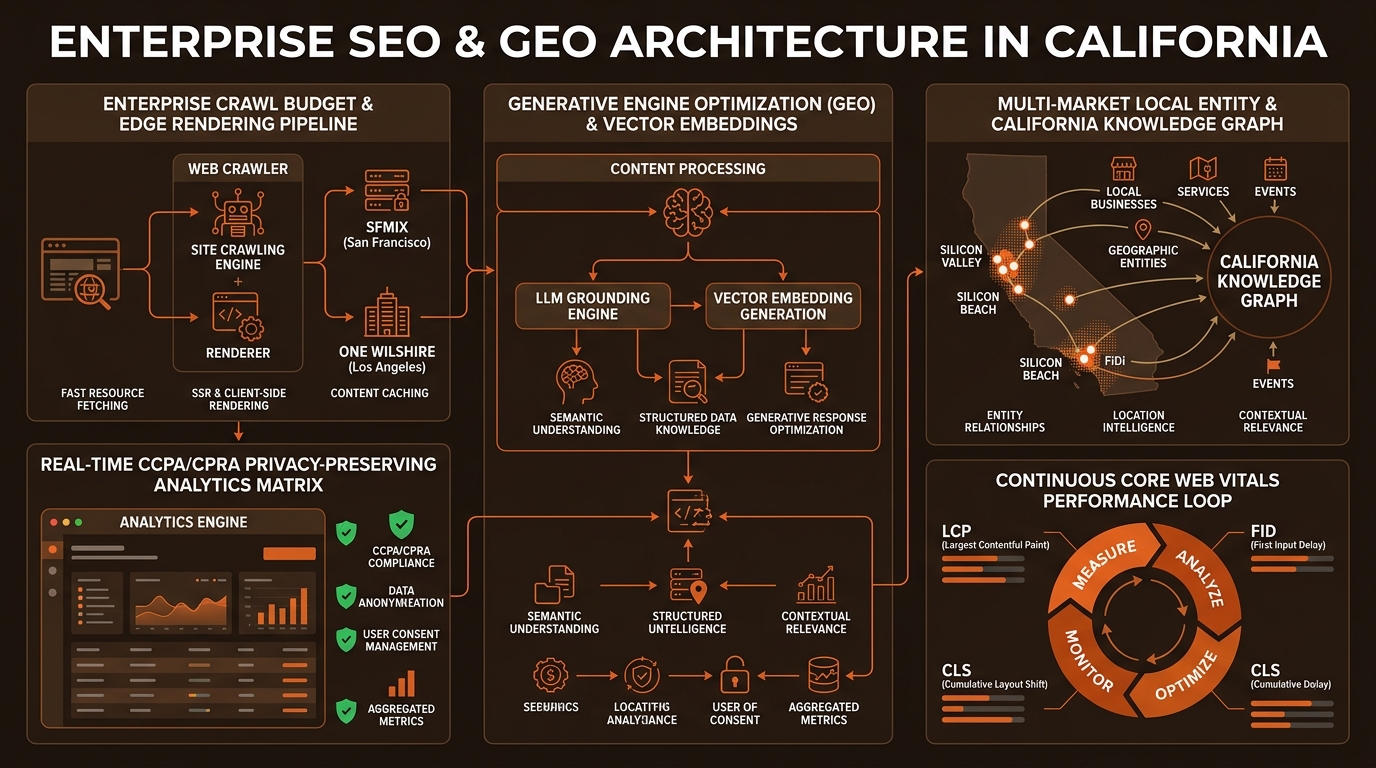
Enterprise websites operating in California often suffer from crawl budget waste caused by unoptimized client-side JavaScript, deep facet navigation, and bloated asset bundles. Search engine bots allocate finite computational resources when indexing complex enterprise domains. Our engineering-led search team audits indexation paths, dynamic rendering pipelines, and server response metrics to ensure high-priority revenue pages are parsed instantly. Through headless setup optimization and intelligent caching headers, we eliminate redundant crawler requests and accelerate the indexation of critical commercial URLs across multi-tenant platforms.
Core Web Vitals represent both direct ranking signals and fundamental usability benchmarks for discerning California users. We optimize load speed, Interaction to Next Paint, and layout shift across desktop and mobile interfaces, adhering strictly to technical guidelines built by the W3C Web Accessibility project. By refining font rendering, eliminating render-blocking scripts, and refining hydration cycles within Next.js environments, we deliver sub-second page speed that satisfies search engine algorithms while reducing bounce rates across competitive California markets.
| setup / feature | Traditional Legacy / Monolith | Southern Edge Modern setup |
|---|---|---|
| Generative Engine Optimization (GEO) & AI Overviews | Fragmented keyword stuffing without vector embeddings or LLM citation grounding | Semantic entity graphs, JSON-LD knowledge schemas, and structured RAG grounding datasets |
| Crawl Budget & Edge Rendering Efficiency | Bloated client-side JavaScript rendering causing crawler timeouts and delayed indexation | Serverless Next.js edge rendering, sub-50ms TTFB, and intelligent header caching |
| Data Privacy & Search Analytics Governance | Non-compliant third-party tracking scripts exposing firms to CPRA and CCPA regulatory penalties | Zero-trust server-side telemetry, cookieless attribution, and full CPPA compliance |
| Multi-Market Entity & Knowledge Graph setup | Generic statewide pages with duplicate metadata and zero localized entity authority | detailed multi-location entity hierarchies linked with Schema.org and trusted knowledge bases |
4. CCPA/CPRA Privacy & Technical Search Analytics
California regulatory environment imposes strict consumer privacy protections through the California Consumer Privacy Act and the California Privacy Rights Act. Traditional search analytics workflows that rely on intrusive tracking mechanisms create substantial regulatory liability for enterprise operators. Southern Edge Marketing implements privacy-first search measurement systems governed by the legal frameworks built by the California Privacy Protection Agency. Our data engineers configure cookieless attribution models, server-side Google Tag Manager containers, and anonymized sale telemetry to ensure complete regulatory compliance without sacrificing actionable intelligence.
Preserving zero-trust data governance while extracting detailed search insights requires advanced data modeling and server-side tracking pipelines. We synchronize privacy-compliant sale APIs directly with your internal CRM systems. It provides clean data flows for search campaign attribution. This setup protects enterprise integrity, shields your brand from legal penalties under California civil code, and supplies executive leadership with transparent visibility into organic traffic valuation, lead velocity, and customer growth costs across all California operations.
SEO Architecture & Delivery Matrix: California
5. Local Entity SEO for Silicon Beach & FiDi
California diverse regional economies require distinct localized search strategies rather than generic statewide campaigns. The venture capital and deep-tech ecosystem in Menlo Park, Palo Alto, and Mountain View operates under entirely different commercial search patterns than the media and creative tech corridor of Silicon Beach in Santa Monica, Venice, and Culver City. Southern Edge Marketing designs multi-location entity hierarchies that build authentic local relevance for every regional office, retail hub, or corporate campus across Southern and Northern California territories.
Our localized search engineering integrates Google Business Profile optimization, local citation graphs, and localized knowledge panel establishment with our dedicated app development services and digital ecosystem. We deploy localized structured data that communicates precise geographic service areas, operating hours, and physical campus attributes to search crawlers. This detailed localization enables California enterprises to capture high-intent local commercial queries, dominate local map packs, and drive qualified institutional traffic across competitive urban centers like San Francisco, Los Angeles, San Diego, and Irvine.
6. Semantic Schema Taxonomy & Knowledge Graphs
Modern search engines rely on semantic graphs to comprehend the real-world relationships between corporate entities, leadership teams, proprietary products, and industry accolades. Southern Edge Marketing engineers complete JSON-LD structured data setups aligned with formal Schema.org vocabularies. We map your enterprise identity using precise RDF microdata, linking corporate entities, founders, executive contributors, patents, and software offerings into an interconnected knowledge web that search engines can parse without ambiguity or hallucination.
Entity interlinking bridges the gap between raw web pages and machine-readable enterprise knowledge. We curate trusted sameAs citations across Wikidata, Crunchbase, official patent registries, and reputable industry directories to reinforce your domain trust. This systematic entity grounding increases your brand eligibility for rich snippets, knowledge panels, and enhanced search features, cementing your enterprise as the definitive trust within California competitive tech, biotechnology, financial, and manufacturing sectors.
7. Low-Latency Edge Peering via SFMIX and Los Angeles Carrier Hotels
Search bot latency and user time-to-first-byte are heavily governed by physical routing distance and internet exchange interconnects across the Pacific Rim. Serving California enterprise audiences demands strategic edge caching and direct peering near major telecom nodes. We architect content delivery strategies that use low-latency routing through regional peering hubs such as the San Francisco Metropolitan Internet Exchange and the world-renowned One Wilshire carrier hotel in downtown Los Angeles.
By deploying edge compute functions and distributed asset caching across California internet gateways, we ensure search crawlers from Google and Microsoft skill immediate, sub-50-millisecond server responses. This low-latency system accelerates indexing frequency, reduces crawl timeout errors, and works synergistically with complete social media management campaigns to convert incoming organic traffic into engaged users. This gives superior digital experiences that search engines reward with elevated search rankings.
8. Conversion Optimization & Full-Lifecycle SEO
Driving high volumes of organic traffic to your California digital properties generates value only when visitors convert into pipeline opportunities, registered users, or closed enterprise contracts. Southern Edge Marketing integrates sale rate optimization directly into every phase of search strategy. We analyze user intent pathways, scroll depth, and interaction heatmaps to refine value propositions, remove friction from form submissions, and align landing page typography with the modern expectations of California business executives.
Our full-lifecycle search governance includes continuous keyword expansion, competitive intelligence monitoring, link equity growth, and quarterly technical audits. We provide enterprise marketing executives with dedicated speed dashboards, transparent algorithmic tracking, and strategic advisory. To discover how our data-driven search strategies can elevate your organic revenue and market trust, contact our search marketing strategists today to schedule an in-depth technical consult with our senior digital engineering team.
Client Reviews
"Southern Edge Marketing transformed our enterprise search presence across Silicon Valley. Their Generative Engine Optimization strategy positioned our AI platform directly inside Google AI Overviews and top organic rankings. Our qualified organic enterprise demo requests surged by 240% within five months. Meanwhile, maintaining strict CCPA privacy compliance."

Marcus Vance
VP of Growth, Apex Neural Systems (Palo Alto, California)
"leading California competitive legal and tech market required deep technical SEO expertise. Southern Edge modernized our Next.js setup, eliminated crawl bottlenecks, and engineered localized entity graphs for our San Francisco and Los Angeles offices. Our organic inbound revenue expanded by 185% year-over-year."

Elena Rostova
Chief Marketing Officer, Pacific Horizon BioTech (Mission Bay, San Francisco, California)
Frequently Asked Questions
GEO optimizes digital assets for synthesis by generative AI models including Google AI Overviews, ChatGPT, and Perplexity. Traditional SEO targets keyword rankings, whereas GEO structures entity data, research benchmarks, and knowledge graphs to secure trusted source citations.
We deploy zero-trust server-side tracking pipelines, cookieless attribution frameworks, and user consent management systems that comply with legal rules built by the California Privacy Protection Agency, preventing regulatory penalties while maintaining precise sale attribution.
Google uses Core Web Vitals, including load speed and Interaction to Next Paint, as direct ranking factors. Discerning California enterprise buyers quickly abandon sluggish interfaces. refining sub-second rendering preserves crawl budget and elevates organic visibility.
We build detailed entity setups using nested Schema.org microdata, dedicated localized landing pages, and verified Google Business Profiles, capturing regional search demand across Silicon Valley, Silicon Beach, Orange County, and San Diego without duplicate content penalties.
We deploy distributed edge caching and serverless rendering pipelines with direct peering through regional internet exchanges like SFMIX in San Francisco and the One Wilshire carrier hotel in Los Angeles, guaranteeing sub-50ms response times for crawlers.
Rich JSON-LD structured data communicates unambiguous entity definitions to search engines, detailing corporate leadership, patents, and software solutions. This unlocks rich snippets, FAQ dropdowns, and trusted Google Knowledge Panels that elevate brand prestige.
Our technical strategists execute continuous automated crawl monitoring alongside in-depth monthly technical audits, actively adjusting internal linking, schema hierarchies, and rendering pipelines to insulate your enterprise against major search engine core updates.
While technical crawl fixes and schema additions often yield indexation improvements within three to six weeks, substantial revenue growth and top competitive rankings typically mature between four to six months as domain authority and backlink equity compound.